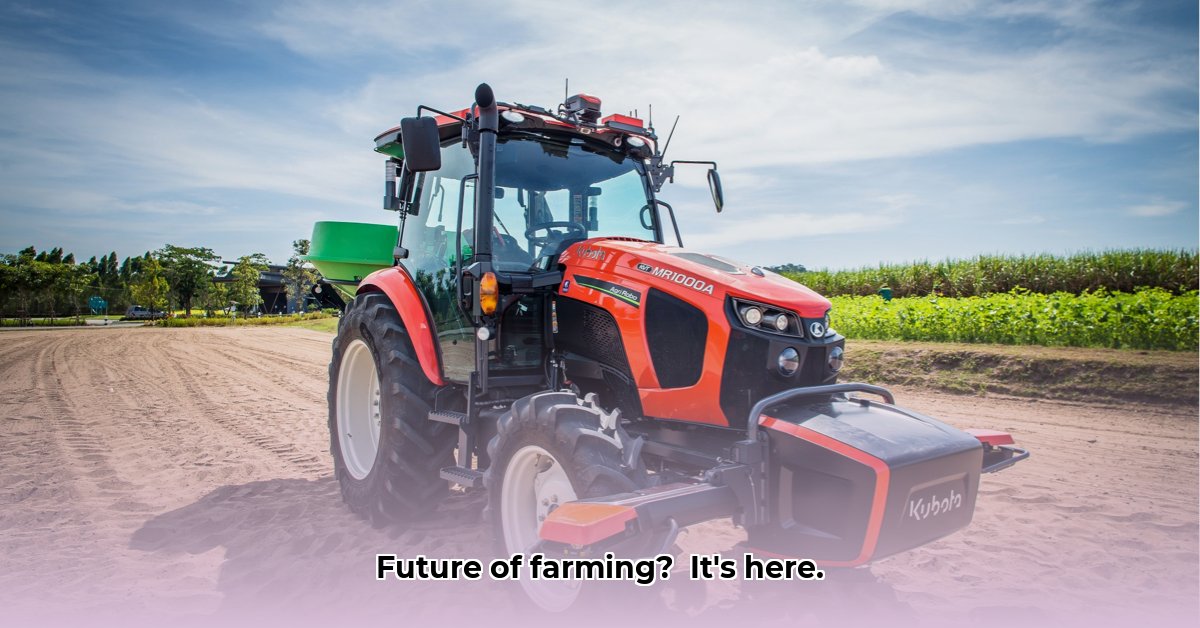
Farming today is a high-stakes game, juggling labor shortages, escalating costs, and the urgent need for sustainable practices. Kubota, a leader in agricultural equipment, is changing the rules with its autonomous tractors—a game-changer poised to revolutionize food production. This article will explore how Kubota's autonomous tractors, the Agri Robo KVT and the Concept Tractor, are tackling these challenges, offering a detailed look at the technology, benefits, risks, and regulatory landscape. Whether you're a farmer, investor, or simply curious about the future of food, this deep dive provides critical insights into the transformative power of autonomous farming. For more on Kubota's four-wheel drive tractors, see this page.
Meeting the Modern Farming Challenge: A New Era in Agriculture
The agricultural industry faces a critical labor shortage. Experienced farmhands are increasingly scarce, making it difficult to maintain efficient and profitable operations. This labor crunch significantly impacts farmers' ability to meet the demands of a growing global population. Kubota's autonomous tractors directly address this challenge by automating labor-intensive tasks, potentially easing the immense pressure on farm operations. How will these advancements affect your farm's bottom line?
The Brains and Brawn Behind the Wheel: Kubota's Autonomous Offerings
Kubota isn't just envisioning the future; it's building it. The company offers two distinct autonomous tractor systems:
The Concept Tractor: This fully electric, AI-powered tractor represents Kubota's vision for tomorrow's farming. Equipped with advanced sensors and intelligent software, it navigates fields with precision, promising both high efficiency and environmental friendliness. Think of it as the Tesla of tractors – futuristic, powerful, and a symbol of innovation in sustainable agriculture.
The Agri Robo KVT: This commercially available system integrates seamlessly with existing Kubota machinery. Farmers can gradually adopt automation without completely overhauling their equipment. It's the reliable workhorse, perfectly suited for farmers seeking a practical transition to automated farming. This system is designed for daily operational demands.
Both tractors embody Kubota's “SOCIAL AGRI” philosophy, showcasing a commitment to improving the lives of farmers worldwide through technological advancement.
The Upsides: A More Efficient and Sustainable Future
The benefits of Kubota's autonomous tractors are substantial:
Increased Efficiency: Autonomous tractors operate continuously, maximizing output and potentially doubling productivity. This signifies a significant leap in operational efficiency.
Precision Farming: Advanced sensors enable precise application of water and fertilizer, minimizing waste, reducing costs, and lessening the environmental impact. This directly contributes to sustainable agricultural practices.
Labor Reduction: Automation frees farmers from labor-intensive tasks, allowing them to focus on strategic management, planning, and other critical business aspects.
The Challenges: Navigating the Road Ahead
Although the potential is immense, several challenges must be addressed:
High Initial Investment: The cost of autonomous tractors presents a substantial financial hurdle for many farmers. A thorough cost-benefit analysis is crucial for long-term economic viability. Dr. Anya Sharma, Agricultural Economist at Cornell University, notes, "The return on investment for autonomous tractors will depend heavily on farm size, crop type, and labor costs."
Regulatory Uncertainty: The regulatory environment surrounding autonomous farm equipment is constantly evolving. Navigating these evolving regulations presents a significant challenge for both manufacturers and farmers.
Farmer Adoption: Overcoming farmer hesitancy towards new technologies is critical for widespread adoption. Providing comprehensive training and readily available technical support are key factors for successful integration.
Mitigating Risks: Planning for Success
Successful implementation requires proactive risk management. The following table highlights potential failure points and mitigation strategies:
| Technology Feature | Likelihood of Failure | Impact of Failure | Mitigation Strategies |
|---|---|---|---|
| Autonomous Navigation | Medium | High | Redundant sensor systems; robust software; rigorous testing and validation; manual override capability. |
| AI-driven Decision Making | Low | Medium | Continuous human oversight; regular software updates; fail-safe programming. |
| Power System | Low | Medium | Regular maintenance; backup power systems; efficient energy management. |
| Communication Systems | Medium | Medium | Redundant communication channels; secure data transmission protocols; offline operational capabilities. |
The Regulatory Landscape: A Collaborative Approach
Successful integration of autonomous tractors requires a collaborative effort. Government policies that support innovation while maintaining safety and environmental standards are essential. This collaborative approach is critical to responsibly shaping the future of agriculture.
Conclusion: The Future is Autonomous
Kubota's autonomous tractors represent a significant step toward a more efficient, precise, and sustainable agricultural future. However, realizing the full potential requires cooperation among farmers, manufacturers, and policymakers. The transformation of agriculture is underway, and autonomous tractors are at the forefront of this exciting evolution.
How to Calculate the Total Cost of Ownership for Kubota Autonomous Tractors
Understanding the total cost of ownership (TCO) is vital for farmers considering autonomous tractors. TCO goes beyond the purchase price, encompassing all operational expenses and long-term considerations. This includes, but is not limited to: depreciation, interest, taxes, insurance, maintenance, fuel, labor, and potential repairs. A thorough TCO calculation is essential for budgeting and evaluating the long-term economic viability of this technology. Comparing this TCO with traditional methods illuminates the potential long-term cost savings and return on investment achievable with Kubota's autonomous solutions.